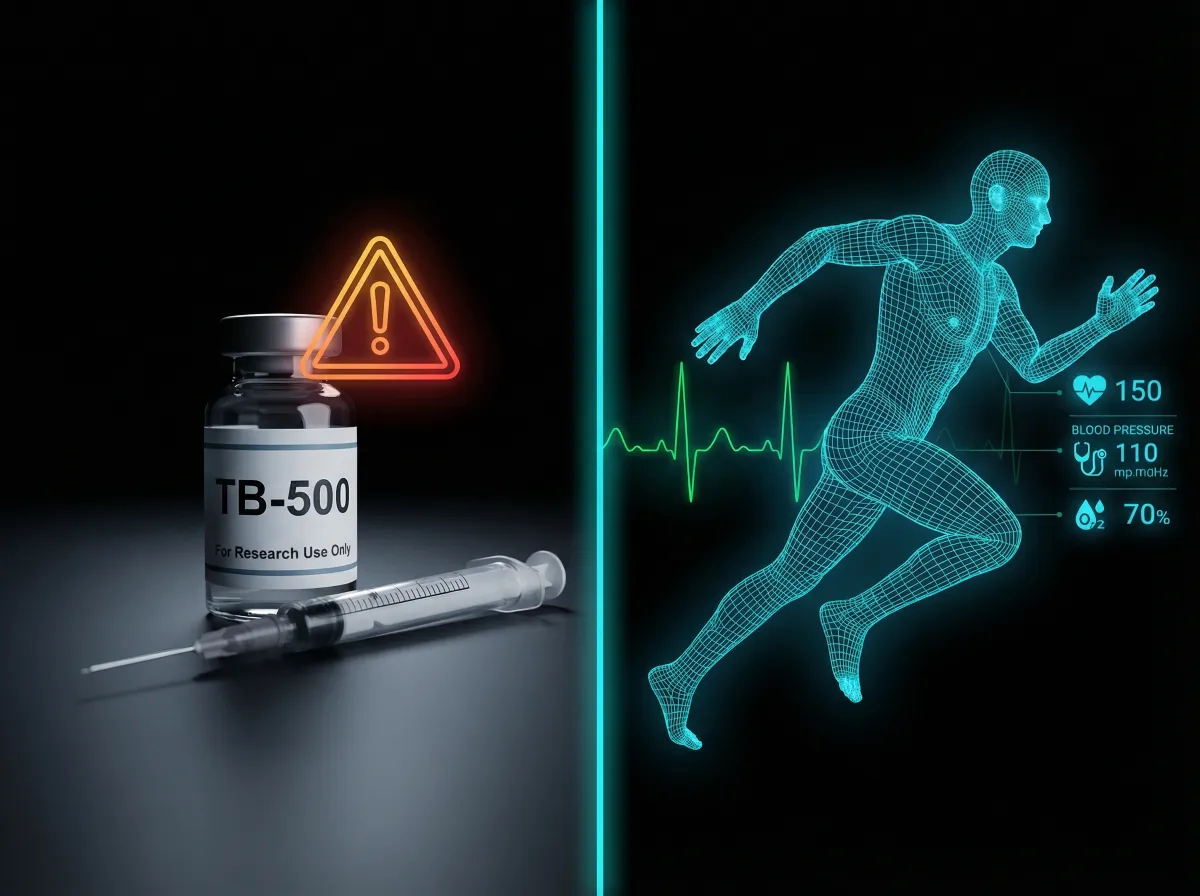


Every peptide guide on the internet tells you what TB-500 can do. Very few tell you what it might do to you. That is a problem if you are making decisions about your own body.
TB-500 (a synthetic fragment of thymosin beta-4) has a genuinely promising safety profile in preclinical research. But "promising" and "proven safe" are not the same thing. This guide covers the actual evidence on side effects, the theoretical risks worth understanding, who should avoid it entirely, and how to reduce your risk if you choose to use it for research purposes.
If you want the full overview of what TB-500 is and how it works, start with the TB-500 Complete Guide. This article goes deep on the safety side only.
This content is for educational purposes only. These compounds are intended for research use. Nothing here is medical advice. Always work with a qualified clinician before making changes to your health protocol.
Quick Safety Summary
Before you read the full breakdown, here is the overview:
| Category | Risk Level | Details |
|---|---|---|
| Injection site reactions | Low | Redness, mild swelling, bruising. Resolves within hours to one day. |
| Headache / head rush | Low | Temporary lightheadedness post-injection. Usually resolves after first few doses. |
| Lethargy / fatigue | Low | Mild tiredness in first week. Body typically adjusts. |
| Nausea | Very Low | Rare. Usually linked to injection timing or individual sensitivity. |
| Cancer risk (theoretical) | Uncertain | TB-500 promotes angiogenesis and cell migration. Theoretical concern for existing tumours. No direct evidence of TB-500 causing cancer. |
| Long-term effects | Unknown | No human long-term safety data. Animal data limited to 6-9 months. |
Now let's unpack each of these properly.
Common Side Effects (Mild, Transient)
Based on both preclinical data and community-reported experiences, the most frequently observed side effects of TB-500 are mild and temporary. They tend to be most pronounced during the first week of a loading phase and diminish as the body adjusts.
Headache or Head Rush
A brief sensation of lightheadedness or a mild headache shortly after injection is the most commonly reported side effect. This appears related to TB-500's vasodilatory properties and its effects on blood flow. It typically lasts 15 to 60 minutes and is most noticeable with the first few injections. Most users report it disappearing entirely after the first week.
Practical note: staying hydrated before and after injection, and avoiding injecting on an empty stomach, tends to reduce this.
Mild Lethargy
Some users report feeling slightly tired or "flat" during the first few days of a loading phase. This is not universal and appears more common at higher doses (above 2.5mg per injection). It typically resolves within 3 to 5 days as the body adapts. If lethargy persists beyond the first week, it may indicate dosing is too aggressive.
Temporary Flushing
Mild skin flushing, particularly of the face and chest, has been reported immediately post-injection. Like the head rush, this is likely tied to the compound's effects on blood vessel dilation. It resolves quickly and is not considered clinically significant.
Injection Site Reactions: Prevention and Management
Injection site reactions are the single most common physical side effect of TB-500 use. They are also the most preventable.
What You Might See
Redness, mild swelling, slight warmth at the injection point, minor bruising, or a small raised bump under the skin. These are normal subcutaneous injection responses, not unique to TB-500. They occur with virtually any injectable compound and typically resolve within a few hours to one day.
What is NOT Normal
Significant swelling that spreads beyond the injection site. Redness that increases over 24 to 48 hours rather than fading. Pus, heat, or streaking radiating from the site. Fever following injection. Any of these could indicate infection and require immediate medical attention.
How to Minimise Injection Site Reactions
Most injection site issues come down to technique, not the compound itself. Follow these protocols:
Clean everything. Alcohol-swab the vial top and the injection site before every injection. Let the alcohol dry before inserting the needle.
Rotate injection sites. Never inject in the same spot twice in a row. Alternate between left and right abdomen, outer thighs, and flank areas. This prevents localised tissue irritation from repeated injections.
Use the right needle. A 29 to 31 gauge insulin syringe (0.5 inch or 12.7mm) is standard for subcutaneous TB-500 injection. Thinner gauge means less tissue trauma.
Inject slowly. Push the plunger steadily over 5 to 10 seconds. Rapid injection forces fluid into a small area and increases the chance of a raised bump or pain.
Let the solution reach room temperature. Injecting cold solution straight from the refrigerator increases discomfort and local irritation. Let the vial sit at room temperature for 10 to 15 minutes before drawing your dose.
For a full walkthrough on proper reconstitution and injection technique, see our guide to reconstituting peptides.
Less Common Side Effects
These are reported less frequently and tend to be individual-specific rather than universal.
Nausea
Rare, and when it occurs, it is usually mild. Nausea appears more frequently when injecting on an empty stomach or when dosing higher than the standard 2.0 to 2.5mg range. Eating a small meal 30 to 60 minutes before injection usually prevents it.
Temporary Increase in Heart Rate
A small number of users report a mild, transient increase in heart rate post-injection. Given TB-500's angiogenic and vasodilatory properties, this is physiologically plausible. It typically lasts under 30 minutes. If persistent or accompanied by chest discomfort, discontinue use and consult a clinician immediately.
Muscle Cramping
Occasionally reported during the loading phase. The mechanism is unclear, but it may relate to shifts in intracellular fluid balance or electrolyte distribution during active tissue repair. Adequate hydration and electrolyte intake (magnesium, potassium, sodium) typically resolves this.
Vivid Dreams or Sleep Changes
Anecdotally reported by a small subset of users, though no mechanistic link has been established. If sleep quality is disrupted, switching injection timing to morning rather than evening may help.
The Cancer Question: Angiogenesis and Cell Proliferation
This is the most serious topic in any TB-500 safety discussion, and the one most often either ignored entirely or blown wildly out of proportion. Here is what the science actually says.
The Concern
Thymosin beta-4 (the parent protein TB-500 is derived from) has been found to be upregulated in several types of metastatic cancer. Research shows elevated TB4 levels in melanoma, colorectal, pancreatic, and non-small cell lung cancers. TB4 facilitates the migration of tumour cells to distant sites by promoting angiogenesis (new blood vessel formation) and cell motility, the same mechanisms that make it effective for tissue repair.
The logic is straightforward: if a compound promotes new blood vessel growth and helps cells move through tissue, and a tumour is a mass of rapidly dividing cells that needs blood supply and the ability to spread, then the compound could theoretically accelerate tumour growth or metastasis.
The Nuance
There is an important distinction between TB-500 promoting cancer and TB-500 being elevated in cancer tissue. Correlation is not causation. Thymosin beta-4 is upregulated in many high-turnover cellular environments, including wound healing, inflammation, and embryonic development. Its presence in cancer tissue may reflect the body's repair response rather than a causative role.
No study has demonstrated that administering TB-500 causes cancer in a healthy organism. The preclinical safety data (more on that below) has not shown tumour formation at any tested dose. However, the absence of evidence is not evidence of absence, especially when the mechanistic pathway for concern is well-established.
The Practical Position
The rational approach: if you have any history of cancer, any current malignancy, or any known predisposition to cancer (strong family history, genetic markers), TB-500 is not worth the risk. Full stop. For healthy individuals with no cancer history, the theoretical risk exists but has not been demonstrated in any controlled study.
This is not a "probably fine, don't worry about it" situation. It is a "the specific risk pathway exists, the evidence hasn't confirmed it, but you should make your decision with full awareness." That is different.
Who Should Not Use TB-500
Based on available research and the compound's known mechanisms, the following groups should avoid TB-500 entirely:
| Group | Reason |
|---|---|
| Anyone with active cancer or a history of cancer | Angiogenic and cell-proliferative mechanisms could theoretically promote tumour growth or metastasis. |
| Individuals on anticoagulant or antiplatelet therapy | TB-500 affects platelet function and blood vessel formation. Combined with blood thinners, this increases bleeding risk. |
| Pregnant or breastfeeding women | Zero safety data. Cell migration and angiogenesis effects during fetal development are completely unstudied. |
| Anyone under 18 | No paediatric safety data. The effects on developing tissues and growth are unknown. |
| Individuals with autoimmune conditions | TB-500 modulates immune cell activity. In autoimmune disorders, immune stimulation could worsen symptoms. Proceed only under direct clinical supervision. |
| Anyone scheduled for surgery | Angiogenic effects and potential impact on blood clotting warrant stopping use at least 2 weeks before any surgical procedure. |
If any of these apply to you, this is not a grey area. Do not use it.
TB-500 vs Thymosin Beta-4: A Critical Distinction
Most safety discussions conflate TB-500 with thymosin beta-4. They are not the same compound.
Thymosin beta-4 is the full 43-amino-acid protein that your body produces naturally. It has been the subject of most clinical and preclinical research, including the Phase 2 trials for cardiac repair and wound healing.
TB-500 is a synthetic peptide fragment, typically corresponding to the active region of thymosin beta-4 (amino acids 17 to 23, the actin-binding domain). It replicates the mechanism of action of the full protein, but it is not structurally identical.
Why this matters for safety: the majority of published safety and efficacy data involves the full thymosin beta-4 protein, not the TB-500 fragment. Assuming that a fragment has the same safety profile as the whole protein is a leap. It may. It may also have different pharmacokinetics, different tissue distribution, or different off-target effects. The honest answer is that fragment-specific safety data is extremely limited.
This distinction is not a reason to panic. It is a reason to apply appropriate caution and not treat preclinical data on the full protein as a blank safety cheque for the synthetic fragment.
What Preclinical Safety Data Actually Shows
Despite the unknowns, the preclinical safety data that does exist is encouraging.
A toxicology assessment published in Regulatory Toxicology and Pharmacology evaluated thymosin beta-4 in rodent models at doses up to 100mg/kg of body weight. No significant adverse effects were observed. To put this in context, a standard human research dose of 2.5mg for a 80kg individual is approximately 0.03mg/kg. The tested dose was over 3,000 times higher.
In wound healing studies, thymosin beta-4 administered over 28-day protocols showed no adverse findings in blood chemistry, organ histology, or behavioural endpoints. The compound was well-tolerated across all dose levels tested.
Cardiac repair studies in mouse and pig models using thymosin beta-4 at therapeutic doses found no arrhythmias, no abnormal tissue proliferation, and no organ toxicity. These studies ran for up to 12 weeks.
The limitation: all of this is animal data. No large-scale, randomised, controlled human safety trial has been completed for either thymosin beta-4 or TB-500. Phase 2 trials (primarily for the full TB4 protein in ophthalmology and cardiac indications) have been conducted but have not advanced to Phase 3 as of early 2026.
Long-Term Unknowns
This is where intellectual honesty requires admitting what we do not know.
Long-term safety beyond 6 to 9 months: No animal study has tracked TB-500 or thymosin beta-4 safety beyond roughly 9 months of continued use. If you are considering extended protocols, you are operating without a safety map.
Cumulative effects on angiogenesis: We do not know whether repeated angiogenic stimulation over months or years has downstream consequences. The body naturally regulates blood vessel formation through a balance of pro- and anti-angiogenic signals. Whether exogenous TB-500 meaningfully disrupts that balance over time is unstudied.
Immune system modulation: Thymosin beta-4 plays roles in immune cell maturation and function. Long-term immunological effects of synthetic TB-500 administration have not been characterised beyond 6-month study windows.
Interaction with ageing biology: For men over 35, who represent the primary user demographic, the compound's effects may interact differently with age-related changes in immune function, hormonal profiles, and cellular repair capacity. This has not been studied.
None of this means TB-500 is dangerous over the long term. It means we cannot say with confidence that it is safe over the long term. Those are different statements, and treating them as interchangeable is how people get hurt.
How to Reduce Your Risk
If you choose to research TB-500, these protocols reduce your exposure to preventable risk:
Get baseline bloodwork before starting. At minimum: complete blood count, comprehensive metabolic panel, C-reactive protein, and a lipid panel. This gives you a reference point to compare against. Repeat bloodwork at the end of your protocol.
Work with a clinician. Find a doctor, ideally in functional medicine or sports medicine, who understands peptide protocols. They can monitor markers you cannot assess yourself and catch problems early.
Source from verified suppliers. Purity issues cause more problems than the compound itself. Contaminants in poorly manufactured peptides can trigger allergic reactions, infections, and unpredictable side effects that have nothing to do with TB-500. Demand third-party certificates of analysis (COA) with HPLC purity testing for every batch.
If you are researching TB-500, Real Peptides provides verified third-party testing and consistent quality. Using that link supports this site.
Follow standard dosing protocols. More is not better with peptides. The 2.0 to 2.5mg twice-weekly loading protocol exists because it reflects the dose range supported by preclinical data. Doubling it does not double the benefit; it only increases your exposure to unknown risks. See our TB-500 Complete Guide for detailed dosing breakdowns.
Take breaks between protocols. Run 8 to 12 week protocols with 4 to 8 week breaks. This gives your body time to return to baseline and reduces the unknowns around cumulative exposure.
Maintain sterile injection technique. Contamination at the injection site is the most preventable cause of serious adverse events. Follow the protocols in our reconstitution guide to the letter.
Potential Interactions With Other Compounds
TB-500's mechanisms create specific interaction concerns that are worth understanding if you are running a broader protocol.
Anticoagulants and Antiplatelet Drugs
TB-500 affects platelet function and blood vessel formation. Combining it with warfarin, heparin, aspirin (at therapeutic doses), clopidogrel, or other blood thinners could increase bleeding risk. If you are on any anticoagulant therapy, do not use TB-500 without explicit medical clearance.
Other Peptides
TB-500 is commonly stacked with BPC-157 in the Wolverine Stack. The available data on this combination, mostly anecdotal but extensive within the biohacking community, suggests the two compounds are well-tolerated together. Their mechanisms are complementary rather than overlapping, which reduces the likelihood of compounding side effects. That said, stacking any two research compounds multiplies the unknowns.
Growth Hormone and IGF-1
Some protocols combine TB-500 with growth hormone or IGF-1 peptides for enhanced recovery. This combination amplifies angiogenic and cell-proliferative effects, which increases the theoretical cancer-related concerns discussed above. If you are running a combined protocol, clinical monitoring becomes significantly more important.
NSAIDs
Standard non-steroidal anti-inflammatories (ibuprofen, naproxen) work by suppressing inflammation. TB-500 modulates inflammation through different pathways. Using both simultaneously is unlikely to cause harm, but the anti-inflammatory effects of NSAIDs may partially counteract some of TB-500's signalling mechanisms. Some practitioners recommend limiting NSAID use during a TB-500 protocol to allow the body's inflammatory-repair cascade to function naturally.
The Bottom Line on TB-500 Safety
TB-500 has a favourable preclinical safety profile. Animal toxicology data shows no significant adverse effects even at extreme doses. Commonly reported side effects in human use are mild, transient, and manageable. The compound appears to be well-tolerated by the vast majority of healthy adults.
But there are real unknowns. No large-scale human safety trial has been completed. The theoretical cancer risk, while unconfirmed, is grounded in legitimate science. Long-term data does not exist. And the TB-500 fragment sold commercially is not identical to the thymosin beta-4 protein studied in most published research.
The responsible position is not "TB-500 is safe" or "TB-500 is dangerous." It is: the evidence so far is encouraging, the known risks are manageable with proper precautions, and the unknowns require you to make an informed decision rather than an assumption.
Get bloodwork. Work with a clinician. Source clean product. Follow tested protocols. And stay honest about the line between what the research shows and what it does not.
If you want a structured framework covering 14 peptide protocols with dosing, stacking, and safety considerations all in one place, grab a copy of The Peptide Edge. It is the playbook I wish existed when I started.

