

Why This Guide Exists
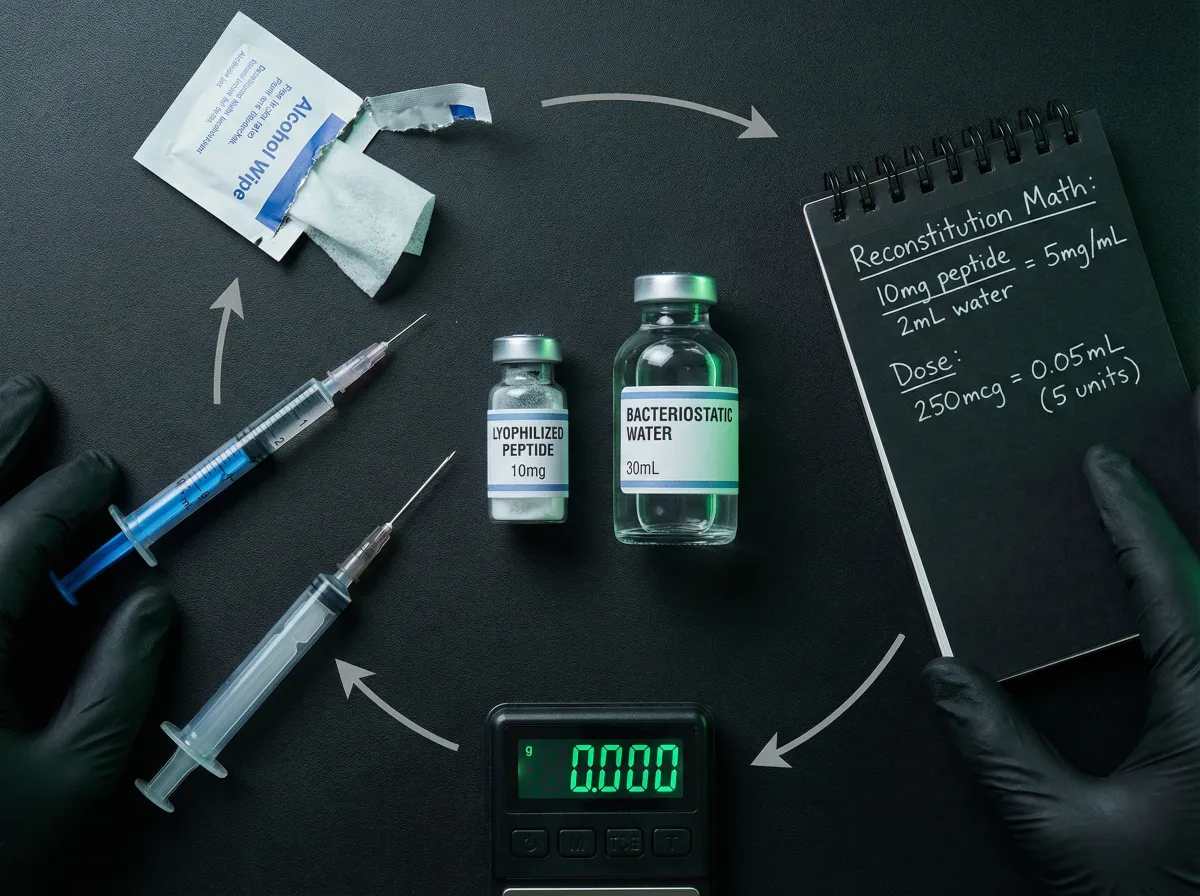
Every peptide you will ever use, whether it is BPC-157, TB-500, Semax, or any other research compound, arrives as a freeze-dried powder in a sealed vial. Before you can dose it, you need to reconstitute it: dissolve the powder in a sterile solvent to create an injectable (or intranasal) solution.
Get this step wrong and you either destroy the peptide, contaminate the vial, or miscalculate your dose. Get it right and you have a stable, accurately dosed solution that lasts weeks in the refrigerator.
This guide walks through the full process, from what you need on your desk to exactly how many units to draw on your syringe for any given dose.
This content is for educational and informational purposes only. These compounds are sold for research use only. Always consult a qualified healthcare professional before considering any protocol.
What You Need
Before you start, gather everything in one place. Working clean and prepared is the single most important factor in safe reconstitution.
Peptide vial: Your lyophilised (freeze-dried) peptide powder, typically in a small glass vial sealed with a rubber stopper and aluminium crimp cap. The label should state the peptide name and the amount in milligrams (e.g. 5mg, 10mg).
Bacteriostatic water (BAC water): Sterile water containing 0.9% benzyl alcohol, which prevents bacterial growth. This is essential for any multi-use vial because you will be piercing the stopper multiple times over days or weeks. Do not use sterile water for injection (which lacks the preservative) unless you plan to use the entire vial in a single session.
Insulin syringes: Standard 1ml (100 unit) insulin syringes with 28-31 gauge needles. These are thin enough to minimise injection discomfort and precise enough for accurate dosing. You will need one syringe to transfer the BAC water and separate syringes for each injection.
Alcohol swabs: For sterilising vial tops before every puncture.
Clean, flat workspace: A countertop or desk wiped down. Wash your hands thoroughly before handling anything.
Step-by-Step Reconstitution
Step 1: Bring Everything to Room Temperature
If your peptide vial or BAC water has been stored in the refrigerator or freezer, let both sit at room temperature for 15-20 minutes before starting. Injecting cold solvent onto cold powder can cause uneven dissolution and clumping.
Step 2: Sterilise the Vial Tops
Remove the coloured plastic cap from both the peptide vial and the BAC water vial to expose the rubber stoppers. Wipe each stopper thoroughly with a fresh alcohol swab and let them air dry for 10-15 seconds. Do this every time you access a vial, not just the first time.
Step 3: Draw the BAC Water
Using a fresh insulin syringe, draw in air equal to the volume of BAC water you plan to use (this makes drawing easier). Insert the needle into the BAC water vial, inject the air, then invert and slowly draw the desired volume. We will cover how to calculate the right volume in the next section.
Step 4: Add Water to the Peptide Vial
This is the step most people rush. Do not rush it.
Insert the needle into the peptide vial through the rubber stopper. Angle the needle so the tip touches the inside wall of the vial, not the powder cake directly. Slowly depress the plunger, letting the water trickle down the glass wall and pool at the bottom. The water will gradually dissolve the powder from below.
Do not squirt the water directly onto the powder. The force can damage the peptide's molecular structure. Slow and gentle against the wall is the method.
Step 5: Dissolve Completely
Once all the water is in the vial, set it down and wait. Most peptides will dissolve within 2-5 minutes without any intervention. If some powder remains clinging to the glass, gently roll the vial between your palms or tilt it slowly back and forth.
Never shake the vial. Vigorous shaking causes aggregation, creating clumps of degraded peptide that reduce potency and can cause injection site irritation. If you see foam or bubbles after shaking, the damage is already done.
The solution should be completely clear when properly dissolved. If it remains cloudy or has visible particles after 30 minutes, something is wrong with either the peptide or the solvent.
Step 6: Store Correctly
Label the vial with the peptide name, concentration (mg/ml), and the date of reconstitution. Store it upright in the refrigerator at 2-8°C (36-46°F), away from light. Most reconstituted peptides remain stable for 28-30 days when stored this way. Some degrade faster; check the specific peptide's stability data.
Dosing Math: How to Calculate Your Draw Volume
This is where people get confused, and the maths is actually simple. You need to know two things: how much peptide is in your vial (in mg), and how much BAC water you added (in ml).
The Formula
Concentration = Peptide amount (mg) ÷ Water volume (ml)
Then to find your draw volume for a specific dose:
Draw volume (ml) = Desired dose (mg) ÷ Concentration (mg/ml)
Example 1: BPC-157
Vial contains: 5mg of BPC-157
You add: 2ml of BAC water
Concentration: 5mg ÷ 2ml = 2.5mg/ml
Your target dose: 250mcg (0.25mg)
Draw volume: 0.25 ÷ 2.5 = 0.1ml = 10 units on an insulin syringe
Example 2: TB-500
Vial contains: 5mg of TB-500
You add: 1ml of BAC water
Concentration: 5mg ÷ 1ml = 5mg/ml
Your target dose: 2.5mg
Draw volume: 2.5 ÷ 5 = 0.5ml = 50 units on an insulin syringe
Example 3: A 10mg Vial
Vial contains: 10mg
You add: 2ml of BAC water
Concentration: 10mg ÷ 2ml = 5mg/ml
Your target dose: 500mcg (0.5mg)
Draw volume: 0.5 ÷ 5 = 0.1ml = 10 units
Understanding Insulin Syringe Units
A standard insulin syringe holds 1ml, which is marked as 100 units. Each small line on the syringe represents 1 unit, which equals 0.01ml. So:
- 10 units = 0.1ml
- 25 units = 0.25ml
- 50 units = 0.5ml
- 100 units = 1.0ml
The key insight: choose how much BAC water you add based on what makes your target dose land on a convenient syringe marking. If your dose works out to 7.3 units, you have made the maths harder than it needs to be. Adjust your water volume so doses fall on clean numbers.
How to Give a Subcutaneous Injection
Most peptides are administered subcutaneously (SubQ), meaning into the fatty layer just beneath the skin. This is straightforward once you have done it a few times.
Site selection: The abdomen (2-3 inches from the navel), outer thigh, or love handle area. Rotate sites to avoid irritation.
Technique: Pinch a fold of skin between your thumb and forefinger. Insert the needle at a 45-90 degree angle into the pinched fold. Depress the plunger slowly and steadily. Withdraw the needle and release the skin. Press gently with a clean swab if there is any bleeding.
For localised healing peptides like BPC-157, inject as close to the injury site as practical. For systemic peptides like TB-500, injection location does not matter because it distributes through the bloodstream regardless.
Common Mistakes to Avoid
Shaking the vial. This is the most common error. Shaking denatures the peptide, creating aggregates that reduce effectiveness. Always swirl gently or let gravity do the work.
Using sterile water instead of bacteriostatic water. Sterile water lacks the benzyl alcohol preservative. Without it, bacteria can colonise the vial after the first puncture. Only use sterile water if you will consume the entire vial in one session.
Squirting water directly onto the powder. The hydraulic force can fragment the peptide chains. Trickle down the wall.
Storing at room temperature. Reconstituted peptides degrade rapidly outside the refrigerator. Room temperature storage can halve the usable life of your vial.
Reusing syringes. Every injection requires a fresh syringe. Reuse dulls the needle (causing more pain and tissue damage) and introduces contamination risk.
Skipping alcohol swabs. Sterilise vial tops before every single access. No exceptions.
Wrong maths. Double-check your concentration calculation before your first draw. A decimal point error means dosing 10x too high or too low.
Quick Reference Table
| Vial Size | BAC Water Added | Concentration | 250mcg Dose | 500mcg Dose | 2.5mg Dose |
|---|---|---|---|---|---|
| 5mg | 1ml | 5mg/ml | 5 units | 10 units | 50 units |
| 5mg | 2ml | 2.5mg/ml | 10 units | 20 units | 100 units |
| 10mg | 2ml | 5mg/ml | 5 units | 10 units | 50 units |
| 10mg | 3ml | 3.33mg/ml | 7.5 units | 15 units | 75 units |
Where to Source Quality Peptides
None of this matters if the powder in your vial is underdosed, contaminated, or not what the label claims. The peptide market is unregulated. Always verify third-party certificates of analysis (COA) showing HPLC purity testing for every batch.
Real Peptides provides verified third-party testing and consistent quality across their range. Using that link supports this site.
Next Steps
Now that you know how to reconstitute and dose peptides, the question is which protocol to run. If you want a structured framework that maps out exactly where each peptide fits, what to stack, and how to progress, The Peptide Edge gives you the complete system.